65% of Martial Arts Insurance Claims Come Down to One Thing
How You Handle Incidents in Your Dojo
Most martial arts instructors believe that insurance claims are caused by accidents.
A student gets injured. Something goes wrong during training. A situation escalates.
But here’s the uncomfortable truth:
In many cases, it’s not the incident that creates the claim—it’s how the incident is handled.
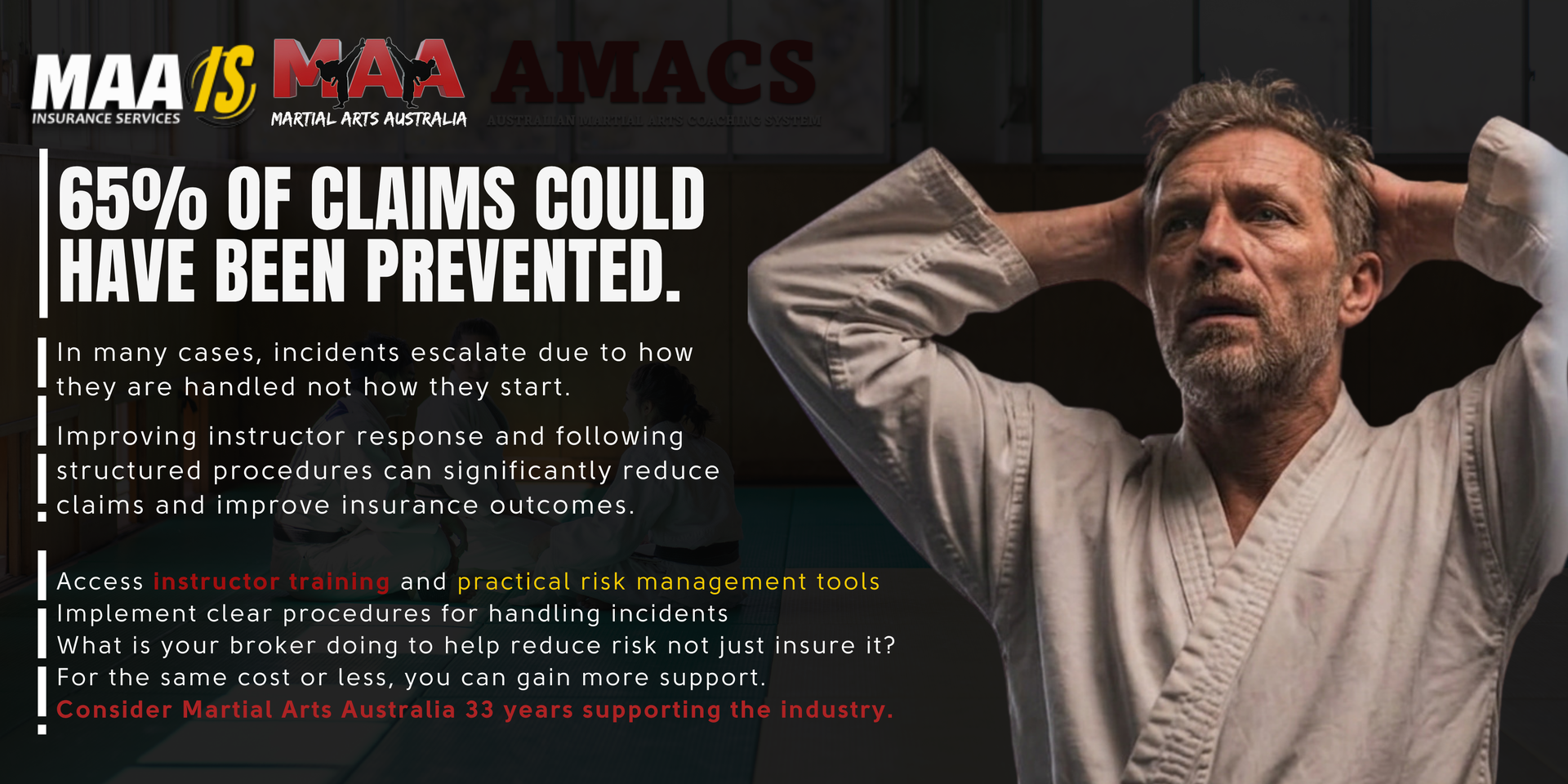
Industry insights suggest that up to 65% of claims are linked to instructor response, not the actual event itself.
For instructors working with Martial Arts Australia, this is one of the most important—and often overlooked—areas of risk management.
The Misconception: “Accidents Cause Claims”
It’s natural to assume that injuries are the main trigger for insurance issues.
But martial arts, by nature, involves controlled physical activity. Minor incidents are expected.
The real issue arises after the incident.
Claims escalate when:
- There is no proper documentation
- Communication is mishandled
- Procedures are unclear or inconsistent
- Legal protections are missing
In other words, the response determines the outcome.
Breaking Down the 65%
Let’s look at what this statistic actually represents.
When claims are analyzed, a large portion reveals patterns such as:
- Incomplete or missing incident reports
- Lack of signed waivers or outdated forms
- Poorly documented safety procedures
- Verbal responses instead of formal processes
- Delayed or incorrect communication with parents or students
These are not unavoidable risks—they are operational gaps.
And operational gaps are fixable.
What Happens When Incidents Are Handled Poorly
A minor situation can escalate quickly when handled incorrectly.
For example:
- A student sustains a minor injury
- No formal report is created
- Communication is informal or unclear
- Documentation cannot support the instructor’s actions
This creates uncertainty—and uncertainty creates liability.
From an insurer’s perspective, lack of documentation increases risk exposure.
And increased risk leads to:
- Higher premiums
- Reduced coverage
- Stricter policy conditions
The Cost of Poor Incident Handling
Many instructors underestimate the long-term impact of a single claim.
Consequences can include:
- Increased premiums for multiple years
- Difficulty renewing policies
- Additional requirements from insurers
- Negative impact on business reputation
Multiply this across the industry, and the result is the current “insurance crunch.”
Why This Problem Is So Common
Most instructors are not trained in risk management.
Their expertise lies in:
- Teaching
- Coaching
- Technical development
But incident handling requires a different skill set:
- Documentation
- Legal awareness
- Structured communication
- Process consistency
Without guidance, instructors rely on instinct—and instinct is not always compliant.
The Difference Between Reaction and Process
There are two ways to handle incidents:
Reactive Approach
- Respond based on the situation
- No standard procedure
- Documentation varies
- High inconsistency
Structured Approach
- Follow a defined process
- Use standardized forms
- Maintain consistent documentation
- Reduce uncertainty
The difference between these two approaches often determines whether a claim escalates—or is resolved cleanly.
The Role of Documentation
Documentation is one of the most powerful tools in risk management.
Proper documentation provides:
- Evidence of correct procedures
- Protection against disputes
- Clarity for insurers
- Consistency across incidents
Without it, even well-handled situations can appear negligent.
Essential Documents Every Dojo Needs
To reduce risk, every martial arts school should have:
- Signed waiver forms (updated and compliant)
- Structured incident report templates
- Risk management policies
- Clear safety procedures
These are not optional—they are foundational.
Communication: The Overlooked Risk Factor
How you communicate after an incident matters just as much as what you do.
Poor communication can:
- Escalate emotions
- Create misunderstandings
- Increase likelihood of claims
Effective communication should be:
- Clear
- Professional
- Documented
This protects both the instructor and the student.
How Small Mistakes Become Big Claims
Let’s connect the dots.
A small mistake—like failing to document an incident—can:
→ Create uncertainty
→ Increase perceived negligence
→ Lead to a claim
→ Raise premiums
This chain reaction is what drives industry-wide insurance issues.
Industry Impact: Why This Affects Everyone
Insurance operates on shared risk.
When claims increase:
- Premiums rise for all schools
- High-risk styles face restrictions
- Coverage becomes harder to obtain
This means one instructor’s mistake can affect the entire industry.
This is why proper incident handling is not just a personal responsibility—it’s an industry obligation.
Closing the Gap With Structured Support
The solution is not to eliminate risk—it’s to manage it effectively.
This is where Martial Arts Australia provides a critical advantage.
Instead of leaving instructors to figure things out alone, MAA offers:
- Standardized documentation templates
- Industry-specific risk management policies
- Guidance on proper incident handling
- Access to experienced professionals
This transforms uncertainty into structure.
Prevention Over Reaction
Most insurance systems are reactive—they deal with problems after they happen.
A better approach is prevention.
By improving:
- Documentation
- Processes
- Communication
Instructors can reduce the likelihood of claims before they occur.
This leads to:
- Lower premiums over time
- More stable coverage
- Stronger business operations
Reviewing Your Current Processes
Many instructors assume their current systems are “good enough.”
But without proper review, gaps often go unnoticed.
A structured review can identify:
- Missing documentation
- Weak procedures
- Areas of risk exposure
Fixing these early can prevent significant issues later.
The Role of Industry-Specific Brokers
Not all brokers understand martial arts.
Generic providers often:
- Apply broad policies
- Miss industry nuances
- Offer limited proactive support
In contrast, MAA’s broker division understands:
- Training environments
- Instructor responsibilities
- Common risk scenarios
This leads to more relevant and effective support.
Immediate Steps You Can Take
To reduce risk starting today:
- Review your waiver forms
- Implement a standard incident report process
- Document all incidents consistently
- Improve communication protocols
- Seek expert guidance where needed
Small improvements can create significant impact.
The Bigger Picture
The 65% statistic highlights a key truth:
Most claims are preventable.
By focusing on how incidents are handled, instructors can:
- Protect their business
- Reduce industry risk
- Contribute to more stable insurance conditions
Conclusion
In martial arts, discipline and structure are fundamental.
The same principles apply to risk management.
It’s not just about avoiding incidents—it’s about handling them correctly when they happen.
Martial Arts Australia provides the systems, tools, and expertise to help instructors do exactly that.
Review your risk approach and explore support here:
https://www.martialartsaustralia.com.au/copy-of-membership