Taekwondo Explained
Dynamic Kicking, Olympic Competition, and a Global Martial Arts Phenomenon
The World's Most Widely Practised Striking Art
Taekwondo is practised by an estimated 100 million people in more than 200 countries, making it by most measures the most widely practised striking martial art in the world. Its inclusion in the Olympic Games since 2000 has cemented its position as the premier competitive kicking sport globally, and its combination of dynamic athleticism, disciplined structure, and practical self-defence application has made it one of the most popular martial arts choices for students of all ages in Australia.
But the statistics and the Olympic profile can sometimes obscure what makes Taekwondo genuinely worth understanding on its own terms — as a martial art with deep philosophical roots, technically sophisticated combat principles, and a developmental pathway that produces remarkable changes in physical capability and personal character.
Origins and Development
Taekwondo's origins lie in Korea's ancient martial traditions, with the practice of kicking-based fighting arts documented across Korean history from the Goguryeo period (37 BCE to 668 CE). The depictions of unarmed combat in ancient tomb murals suggest a high-kicking, dynamic fighting tradition that predates the modern codification of Taekwondo by more than a millennium.
Modern Taekwondo was formalised in the mid-20th century, following Korea's liberation from Japanese occupation and the subsequent effort to establish a distinctly Korean national martial art. General Choi Hong Hi, widely credited as the founding figure of modern Taekwondo, synthesised existing Korean martial arts traditions — particularly Tang Soo Do and the older Taekkyeon — with elements of his Shotokan Karate training to create the systematised art presented to the Korean military in 1954.
The establishment of the World Taekwondo Federation (now World Taekwondo) and the Kukkiwon — the official Taekwondo headquarters in Seoul that governs the global Dan grading system — in the 1970s created the institutional framework for Taekwondo's global expansion. Olympic inclusion at the 2000 Sydney Games was the culmination of decades of political and organisational work and brought Taekwondo to the attention of a global audience that had perhaps previously known it primarily through demonstrations of spectacular breaking techniques.
The Technical Emphasis on Kicking
Taekwondo's defining technical characteristic is its extraordinary development of kicking technique. While most striking arts include kicks in their repertoire, no style has developed kicking to the degree of sophistication, diversity, and sheer physical expression that Taekwondo achieves.
A competent Taekwondo practitioner has access to a kicking vocabulary that includes:
- Front kick (ap chagi) — the foundational kick, delivered with the ball of the foot to the midsection or face
- Roundhouse kick (dollyo chagi) — a sweeping circular kick, the most commonly used kick in both competition and self-defence contexts
- Side kick (yop chagi) — a powerful thrusting kick delivered sideways, with tremendous force generation capacity
- Back kick (dwi chagi) — a rear heel thrust requiring rotation and generating significant power
- Spinning heel kick (dwi huryeo chagi) — a spinning technique using the heel, one of Taekwondo's most powerful techniques
- Jumping and flying kicks — aerial variations of all major kicks, developed both for sport and spectacular demonstration
The development of this extensive kicking arsenal requires considerable investment in flexibility, strength, balance, and coordination — attributes that benefit practitioners well beyond any martial arts context.
Philosophy and the Tenets of Taekwondo
Taekwondo is built on a clear philosophical framework that distinguishes serious practice from mere sports participation. The five tenets — Courtesy (Ye Ui), Integrity (Yom Chi), Perseverance (In Nae), Self-Control (Guk Gi), and Indomitable Spirit (Baekjul Boolgool) — are not decorative additions to the curriculum. They are actively taught, regularly discussed, and used as a framework for evaluating the character development of practitioners alongside their technical progress.
The pattern (poomsae/hyung) system provides the structure for transmitting these principles alongside technical content. Patterns — choreographed sequences of techniques performed solo — encode both the fighting principles of the system and the philosophical values it aims to develop. Each grade in the belt progression is associated with specific patterns, providing clear developmental benchmarks and a sense of meaningful progression.
Taekwondo for All Ages
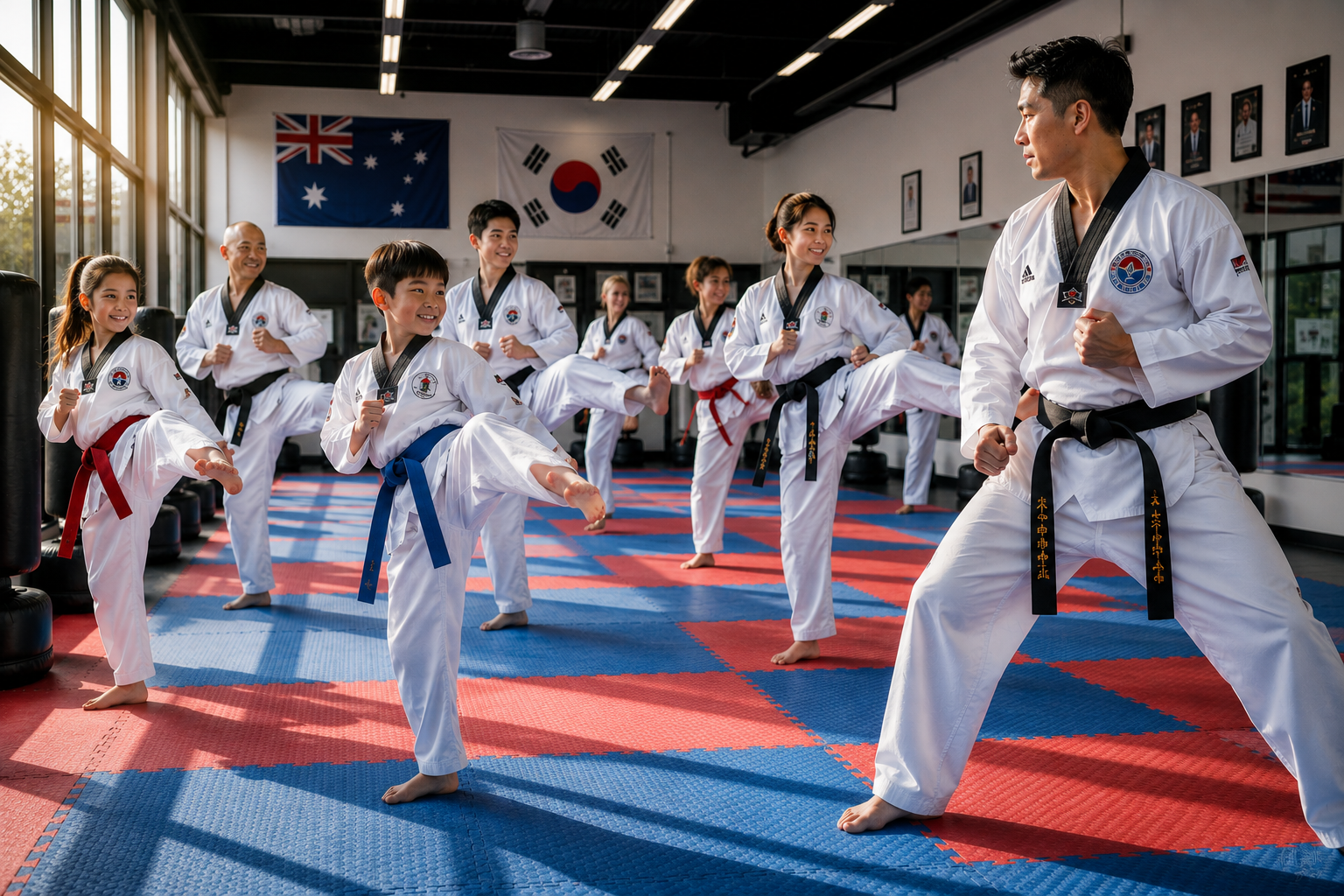
One of Taekwondo's genuine strengths as a choice for Australian families is its documented effectiveness with students across a very wide age range. Children from as young as four or five can begin age-appropriate Taekwondo training that builds coordination, focus, confidence, and physical capability in a structured, safe environment. The belt system provides clear, achievable goals that sustain motivation over the years-long journey to black belt and beyond.
Adults — including those beginning later in life — find that Taekwondo provides an exceptional fitness challenge alongside practical self-defence skills and a community of practice. Older adults can modify training intensity while still accessing the full technical and philosophical depth of the art.
Competitive Taekwondo in Australia
Australia has a strong competitive Taekwondo tradition, with Australian athletes competing at World Championships, Commonwealth Games, and Olympic Games. The national pathway program operated through Taekwondo Australia provides competition opportunities from junior club level through to national team selection. For students with competitive aspirations, Taekwondo offers one of the most clearly structured athletic development pathways in all of martial arts.
Martial Arts Australia supports Taekwondo clubs across the country through our club directory, insurance services, and instructor development programs. Finding a quality school is the first step — our directory is designed to make that easy.