Wing Chun Explained
Close-Range Combat, Centreline Theory, and Why This Style Keeps Growing
A System Built for Reality
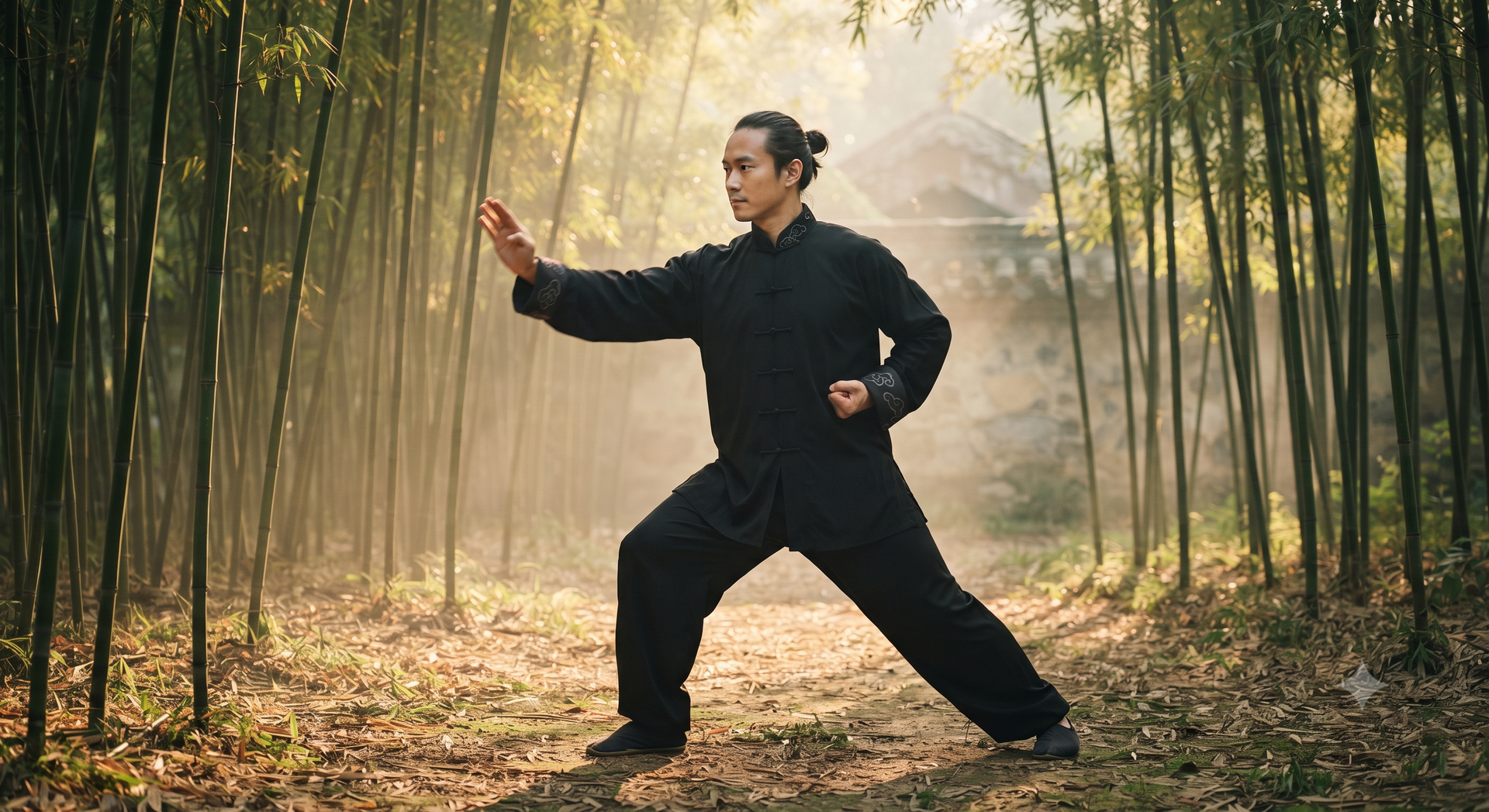
Wing Chun is one of the most widely recognised and consistently growing Chinese martial arts in the world today. Unlike many traditional systems whose popularity has fluctuated with trends and cultural shifts, Wing Chun has maintained a steady upward trajectory in interest — driven in no small part by its reputation as a practical, efficiency-focused self-defence system, and by the global fame of its most celebrated practitioner: Bruce Lee, who trained extensively in Wing Chun under the legendary Ip Man before developing his own approach.
But Wing Chun's appeal goes well beyond celebrity association. It is a system built on coherent, testable principles — one that rewards analytical thinking as much as physical athleticism, and that offers a genuinely different perspective on how effective close-range combat works.
Origins and History
Wing Chun's origins are somewhat contested, as with many traditional Chinese martial arts, but the most widely accepted account traces the system to southern China during the Qing Dynasty. The founding story — involving a Shaolin nun named Ng Mui and her student Yim Wing Chun, after whom the art is named — is likely apocryphal in its specifics, but it reflects important truths about the system's design philosophy: Wing Chun was developed with efficiency as the primary criterion, deliberately stripping away what was impractical and focusing on what worked in real confrontations.
The system was systematised and transmitted through Guangdong Province, eventually reaching Hong Kong where Ip Man would become its most famous 20th-century exponent. Ip Man's decision to teach Wing Chun openly — breaking from the traditional practice of only teaching within family or closed community networks — transformed it from a regional style into a global one.
The Centreline Theory
At the heart of Wing Chun's technical approach is the centreline theory — a concept that gives the system much of its strategic coherence.
The centreline is an imaginary vertical line running through the centre of the body, from the crown of the head to the groin. Wing Chun theory holds that the most vital targets on the human body — the face, throat, solar plexus, and groin — all lie on or close to the centreline. The strategic logic that follows from this is straightforward: control the centreline, and you control the fight.
In practical terms, centreline theory shapes Wing Chun's approach to striking, guarding, and positioning:
- Strikes travel along the shortest path between practitioner and opponent — the direct line through the centreline — rather than taking circular or hooking paths.
- The guard position positions both hands along the centreline, protecting the most vulnerable targets while keeping striking tools in their most efficient position for attack.
- Footwork is designed to maintain centreline advantage, allowing the practitioner to simultaneously attack and defend by occupying the space directly in front of the opponent.
Close-Range Specialisation
Wing Chun is explicitly designed for close-range engagements. While it includes techniques for dealing with opponents at medium and longer ranges, the system finds its greatest advantage in the close-range space where many fighting systems are less well-developed.
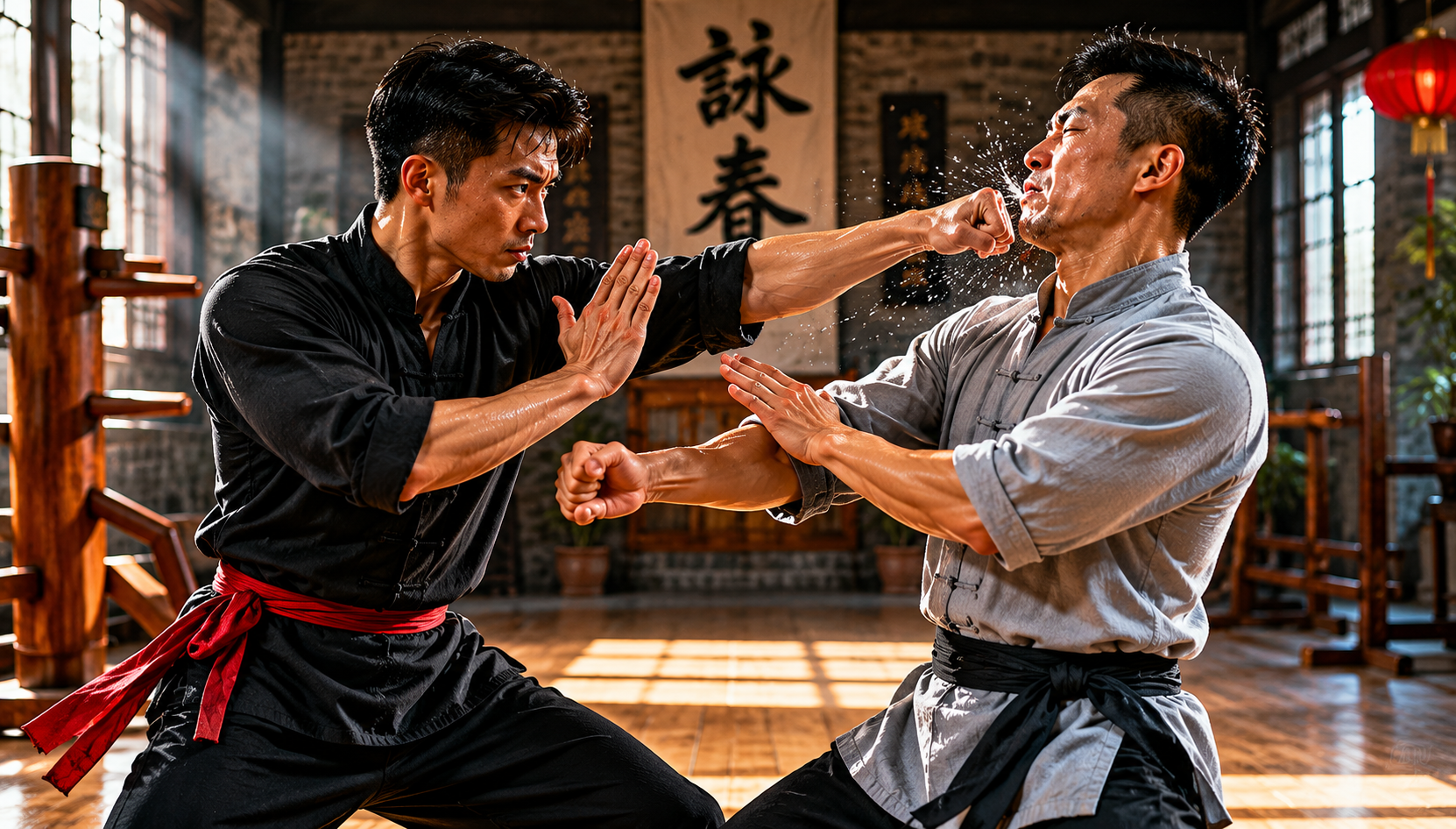
The signature technique of Wing Chun — the chain punch (lien wan kuen) — is designed to overwhelm an opponent at close range with a rapid sequence of centreline punches. Because the punches travel along the shortest possible path, they can be delivered at a rate and from a range that larger, more committed strikes cannot match.
The other foundational concept of close-range Wing Chun practice is the idea of simultaneous attack and defence — intercepting an opponent's incoming technique while simultaneously delivering a counter — rather than blocking first, then striking. This principle dramatically increases the efficiency of defensive responses.
Chi Sao: Tactile Training
One of the most distinctive training methods in Wing Chun is chi sao, or 'sticky hands.' Chi sao is a sensitivity training exercise in which two practitioners maintain contact through their forearms while attempting to find openings and apply techniques against each other.
The purpose of chi sao is to develop tactile sensitivity — the ability to read an opponent's intention and position through touch rather than sight alone. At close range, where visual processing can lag behind the speed of events, tactile sensitivity becomes a significant advantage. Chi sao trains practitioners to respond automatically to what they feel through contact, developing reflexive responses that do not depend on seeing the attack coming.
This training methodology is one of Wing Chun's most valuable contributions to martial arts pedagogy. It develops qualities — relaxed awareness, sensitivity, and responsive flow — that have genuine application in both combat and other areas of life requiring attentiveness and adaptability.
The Three Forms
Traditional Wing Chun is structured around three empty-hand forms, each developing specific aspects of the system:
- Siu Lim Tao (Little Idea Form) — the foundation of all Wing Chun practice. Performed slowly and without stepping, Siu Lim Tao develops correct positioning, structural alignment, and the fundamental hand techniques of the system. It is the most important form in Wing Chun and is practised throughout a practitioner's entire career.
- Chum Kiu (Seeking the Bridge) — introduces footwork, turning, and the concept of 'bridging' — making contact with the opponent and controlling their centreline through that contact.
- Biu Gee (Thrusting Fingers) — the most advanced empty-hand form, containing emergency techniques and the development of explosive power generation.
The curriculum also includes two weapons forms — the Mook Yan Jong (wooden dummy) and the long pole and butterfly swords forms — each developing specific qualities that complement the empty-hand training.
Wing Chun in Australia Today
Australia has a vibrant Wing Chun community representing multiple lineages — Ip Man's line being most prevalent, but with significant representation from other traditions including Yuen Kay Shan and the older Guangzhou transmission lines. The quality and approach of schools vary, as with any art, and Martial Arts Australia encourages prospective students to visit multiple schools, understand the instructor's background and lineage, and assess whether the training environment and methodology suit their goals.
Wing Chun is particularly well-suited to students who value intelligent, principles-based learning over athleticism, who are interested in the theoretical dimension of martial arts as well as the physical, and who want a system that rewards patience and analytical thinking.