Shotokai Karate

Graham Slater • July 17, 2026

Fluid Movement, Philosophy and Personal Development
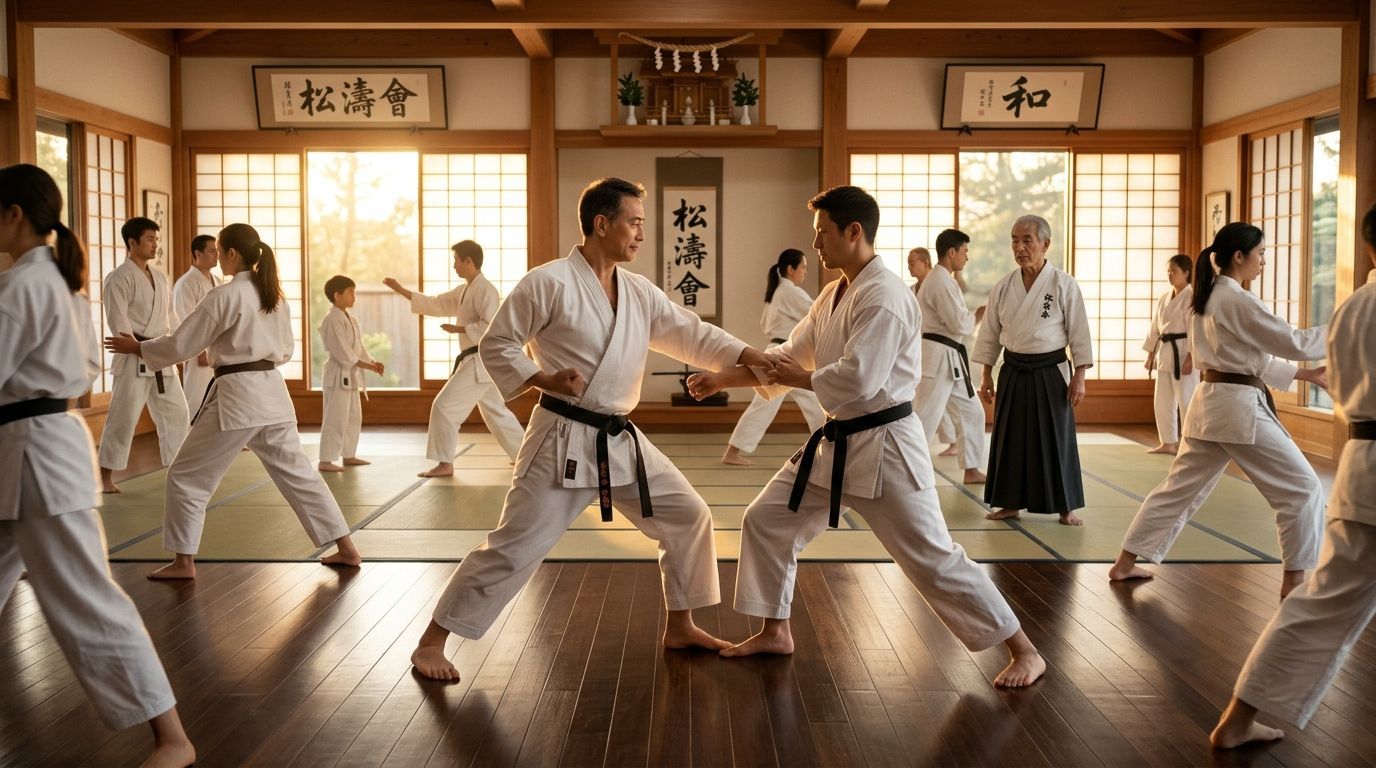
In the wide world of martial arts, most people have a mental image of Karate that involves rigid movements, sharp stops, and the percussive sound of a punch hitting a padded target. But if you were to step into a Shotokai dojo, that image might be turned on its head. Instead of the staccato "snap" of many modern styles, you would see movements that look more like a river—uninterrupted, heavy, and incredibly fluid.

Shotokai is often called the "hidden" side of the Karate world. While its cousin, Shotokan, became a global sporting phenomenon, Shotokai took a different path. It retreated from the world of trophies and tournaments to focus on something deeper: the pursuit of natural movement, the integration of mind and body, and the philosophical roots of Gichin Funakoshi’s original teachings.


As part of our ongoing Martial Arts Australia series, "Every Style Has Value," we are exploring the unique world of Shotokai. It is a style that doesn't just ask you to fight an opponent; it asks you to understand yourself.


The Origin Story: The Split from Competition

To understand Shotokai, you have to understand the history of the "Shotokan" name. As we explored in previous articles, Shoto was the pen name of Gichin Funakoshi, and Kan meant "house." However, after Funakoshi’s passing, a philosophical rift formed in the Karate world.

One group, the Japan Karate Association (JKA), wanted to move Karate toward a competitive sporting format to help it spread across the globe. Another group, led by Funakoshi’s top student, Shigeru Egami, was deeply opposed to this. Egami felt that competition introduced ego, tension, and a "winning at all costs" mentality that destroyed the spiritual essence of the art.


Egami’s group became known as the Shotokai (The Association of Shoto). Under his leadership, the style underwent a radical transformation. Egami began to question the very way Karate techniques were performed. He found that by trying to be "strong" and "hard," practitioners were actually becoming slow and tense. He spent years experimenting with his own body, eventually developing a method of movement that emphasized total relaxation and a "natural" flow of energy.


The Core Technical Philosophy: Relaxation is Power

The most striking difference between Shotokai and other styles of Karate is the absence of the "snap" or the "recoil." In most styles, a punch is retracted quickly after impact. In Shotokai, the punch is delivered with the weight of the entire body moving forward, and it is "thrown" through the target.


1. The Fluidity of Movement

Shotokai practitioners believe that tension is the enemy of speed and power. If your muscles are tense, you are fighting against yourself. By remaining completely relaxed until the moment of impact, a Shotokai practitioner can move with incredible speed.

This fluidity isn't just about the arms; it’s about the whole body moving as a single, unified wave. When a Shotokai practitioner moves, they don't just step; they "glide," maintaining a constant level of pressure and presence.


2. The Concept of "Irimi" (Entering)

In many martial arts, there is a "block, then counter-attack" rhythm. Shotokai prioritises Irimi, or "entering." Instead of waiting for an attack to arrive and then reacting, the Shotokai practitioner seeks to enter the opponent's space at the exact moment the attack begins. By moving into the heart of the conflict with a relaxed but heavy momentum, they neutralize the threat before it can reach full power.


3. The Rejection of Competition

You will not find Shotokai tournaments. There are no medals or point-scoring matches. This is a deliberate choice. The philosophy is that if you are training to "beat" someone else, your focus is outward and competitive. If you are training to "master" yourself, your focus is inward and cooperative.


In a Shotokai dojo, sparring (Kumite) is usually cooperative. Partners push each other to find their limits, helping one another understand distance, timing, and the "feeling" of the technique. This creates a unique atmosphere of mutual growth rather than rivalry.


Shotokai as a Path to Personal Development

For many Australians, the draw of Shotokai isn't about learning to win a cage fight; it’s about the internal benefits. Because the style is so focused on the integration of the mind and body, it acts as a powerful tool for personal growth.


Mental Clarity and Stress Management

The deep, focused nature of Shotokai training requires a level of "presence" that is rare in modern life. You cannot perform a Shotokai movement correctly if your mind is wandering to your work emails or your to-do list. The requirement for total relaxation under the pressure of movement acts as a form of active mindfulness. Practitioners often find that the "calmness" they cultivate on the mat begins to seep into their professional and personal lives.


Leadership and Discipline

In our "Every Style Has Value" project, we often talk about how martial arts builds character. In Shotokai, this is achieved through the constant refinement of movement. There is a saying in the style: "The move is never finished." This mindset of continuous improvement and the humility to constantly "start again" is a powerful lesson in leadership. It teaches you that true mastery isn't about reaching a destination, but about the quality of the journey.


Resilience Through Movement

Shotokai training can be physically demanding, often involving long periods of holding deep stances or repeating movements until the body is exhausted. It is at this point of exhaustion that the "mind" takes over. By pushing through physical fatigue without losing relaxation, students build a unique kind of resilience—one that isn't based on "toughness," but on the ability to remain soft and adaptable when things get difficult.


The Physical Benefits: Longevity and Mobility

Because Shotokai rejects the "jarring" impacts of some other styles, it is often seen as a "lifetime" martial art.

  • Joint Health: By focusing on relaxation and fluid transitions, Shotokai puts less stress on the knees and shoulders than styles that rely on "locking" joints at the end of a punch.
  • Core Integration: Everything in Shotokai comes from the Hara (the center of the body). This builds incredible core strength and functional stability, which is vital as we age.
  • Balance and Coordination: The expansive, low-to-the-ground movements of Shotokai challenge the body's proprioception (the sense of where you are in space), leading to better balance in daily life.

In this way, Shotokai shares a similar "wellness" DNA with arts like Tai Chi or Aikido, while still maintaining the technical framework of traditional Karate.


Shotokai in the Australian Community

Australia has a small but dedicated Shotokai community. It tends to attract a certain type of practitioner—someone who perhaps started in a more "hard" style and is looking for a deeper philosophical connection, or someone who is drawn to the artistic and movement-based aspects of martial arts.


In a country like Australia, where we often prioritize high-impact sports and competition, Shotokai offers a vital counter-balance. it reminds us that there is power in softness, and there is strength in cooperation.

Many Australian Shotokai dojos pride themselves on being inclusive spaces where the focus is on the individual's progress rather than their ability to "win." This makes it an excellent choice for families and professionals who are looking for a community that values character and health above all else.


Every Style Has Value: The Lesson of Shotokai

At Martial Arts Australia, our mission with this series is to show that there is no "one size fits all" in the martial arts world.

  • If Kyokushin is the "Iron" that tests its strength against other iron...
  • And Shotokan is the "Steel" that is refined into a precise edge...
  • Then Shotokai is the "Water" that flows around obstacles and eventually wears them away.


The lesson of Shotokai is that strength is not always about tension. Sometimes, the most powerful thing you can do is let go of your ego, relax your shoulders, and move with the natural flow of the situation. It teaches us that the greatest opponent we will ever face is the "rigidity" within ourselves—both in our bodies and our minds.


Is Shotokai Right for You?

Shotokai is a beautiful, demanding, and deeply philosophical art. It might be the right fit for you if:

  • You seek depth over trophies: You are more interested in self-discovery and "the way" than in winning tournaments.
  • You enjoy fluid movement: You find the "snap and lock" of traditional styles too jarring and prefer a more continuous, "liquid" style of movement.
  • You want a lifetime practice: You are looking for an art that you can practice well into your senior years, focusing on health and mobility.
  • You value the "Art" in Martial Arts: You appreciate the aesthetic and historical depth of Karate as a cultural tradition.


You don't need to be an athlete to start. Shotokai meets you where you are, and through the practice of relaxation, it helps you find a level of power and grace you might not have known you possessed.


Start Your Shotokai Journey

Are you ready to explore the "fluid" side of Karate? Australia is home to instructors who have dedicated their lives to preserving the unique vision of Shigeru Egami and the spiritual legacy of Gichin Funakoshi.


Martial Arts Australia is here to help you find a community that supports your personal development. Whether you are looking for physical health, mental focus, or a deeper understanding of martial philosophy, the Shotokai path is open.
Martial Arts Masters Blog

By Graham Slater July 16, 2026
Structure, Discipline and Traditional Foundation
By Graham Slater July 10, 2026
Speed, Power and Biomechanical Efficiency
By Graham Slater July 9, 2026
If you walk into any martial arts school across Australia on a Tuesday night, you’ll witness a scene that is both deeply familiar and remarkably unique. In one suburb, you might see the crisp, white uniforms of a Shotokan Karate class moving in perfect, powerful unison. Five kilometres away, a group might be practicing the slow, rhythmic flow of Tai Chi in a local park. Elsewhere, a high-energy Taekwondo class is focused on the snap of a roundhouse kick, while a Wing Chun practitioner is working on the quiet, tactile sensitivity of Chi Sao . To the uninitiated, these scenes might look like entirely different worlds. But to those within the community, they are all threads in the same rich, global tapestry. For years, the martial arts world has occasionally been distracted by the "style vs. style" debate—an attempt to find a singular "best" way to train. However, as our community matures, we are seeing a shift toward a much more nuanced perspective: the understanding that every style has inherent value. This isn't just a polite sentiment; it is a recognition that martial arts systems evolved to solve different human problems. This article serves as the opening chapter of a long-term educational project by Martial Arts Australia . Our goal is to explore the history, philosophy, and technical beauty of the world’s many systems, moving away from division and toward a culture of mutual respect. The Roots of Diversity: Why We Don’t All Move the Same Way The sheer variety of martial arts can be overwhelming. Why are some styles low and rooted, while others are upright and mobile? Why does one focus on breathing and another on impact? The answer lies in history and geography. Martial arts did not develop in a vacuum; they were shaped by the specific challenges of the societies that created them.  Culture and Warfare: Systems designed for the battlefield, where soldiers wore heavy armour, naturally prioritised stability and weapons-based movements. Conversely, systems that emerged for civilian self-defence in crowded marketplace settings often focused on close-quarters grappling and quick, deceptive strikes. Geography: Terrain plays a hidden role in how we move. Styles developed in mountainous regions often emphasise strong legs and balance, while those from softer, flatter ground might allow for more expansive footwork. Philosophy and Religion: Many arts were influenced by Zen Buddhism, Taoism, or Confucianism. For these systems, the goal wasn't just physical victory, but spiritual cultivation. The movement became a form of "moving meditation," where the focus was on the internal state of the practitioner as much as the external technique. When we understand why a style looks the way it does, the "better or worse" argument fades away. We begin to see a Hapkido joint lock or a Wushu form not as a competing product, but as a sophisticated solution to a specific historical or personal need. The Modern Practitioner: A Journey of Many Paths In the past, a student might have joined a local club simply because it was the only one in town. Today, Australians have incredible access to a world of traditions. What’s interesting is that while most people start for a singular reason—fitness, for example—they often stay for reasons they never anticipated. The Physical Layer: Fitness and Function For many, the journey begins with the body. Martial arts offers a unique kind of "functional" fitness that a gym workout rarely matches. It’s about coordination, explosive power, and flexibility. A teenager might find their athletic identity in the high-kicking demands of Taekwondo, while an older adult might find that Tai Chi provides a path to mobility and balance that preserves their joints and improves their quality of life. The Mental Layer: Discipline and Resilience Beyond the physical, there is the "hidden" curriculum of the dojo. Martial arts is one of the few environments left in modern life where we are encouraged to fail, learn, and try again in a safe, structured way. Confidence: This isn't about arrogance; it’s the quiet self-assurance that comes from knowing you can handle physical and mental pressure. Focus: In an age of digital distraction, the requirement to be "present" during a kata or a sparring session is a powerful mental reset. Emotional Control: Learning to keep a cool head when you are tired or frustrated is a skill that translates directly to the boardroom, the classroom, and the home. Understanding the Focus Areas To appreciate the diversity of styles, it helps to look at where they place their emphasis. While most comprehensive systems touch on everything, every school usually has a "north star" that guides its training. 1. The Self-Defence Focus Some systems are built from the ground up for practical, real-world application. They prioritise efficiency over aesthetics. You’ll see this in styles like Wing Chun , which focuses on centreline control and economical movement, or Hapkido , which uses an opponent's energy against them through redirection and joint manipulation. For these practitioners, the value lies in situational awareness and the ability to end a conflict as quickly as possible. 2. The Competition and Sport Focus Others have evolved into highly sophisticated sporting structures. Taekwondo , Kyokushin Karate , and Wushu have all developed tournament formats that push the limits of human athleticism. Competition isn't just about winning medals; it’s a laboratory for testing timing, speed, and mental toughness under high-pressure conditions. It has also been the primary way martial arts has been introduced to the wider global public. 3. The Health and Wellness Focus For some, the "art" is a path to longevity. Tai Chi is perhaps the most famous example, but many traditional systems include "internal" components that focus on breathing, posture, and the cultivation of energy. The value here is in the long-term maintenance of the human machine—keeping the body supple and the mind calm well into old age. 4. The Traditional and Philosophical Focus Many schools see themselves as the custodians of history. They preserve the lineage of the founders, the traditional etiquette, and the philosophical teachings that have been passed down for generations. Styles like Shotokan or Shaolin Kung Fu often maintain strict traditional frameworks. For these practitioners, the value is in the connection to something larger than themselves—a lineage that stretches back through time. Deep Dive: The Evolution of Karate Karate is a perfect example of how one "root" can grow into a forest of diverse styles. Originating in Okinawa as a blend of local traditions and Chinese influences, it eventually migrated to mainland Japan and then the world. Kyokushin: Known for its "Full Contact" philosophy, it prioritises physical toughness and the ability to endure. Goju Ryu: A beautiful blend of "hard" and "soft," focusing on close-range fighting and deep, circular breathing. Shotokan: Characterised by long, deep stances and powerful, linear techniques, it emphasises discipline and fundamental perfection. Wado Ryu: A unique blend that incorporates Japanese Jujutsu, focusing on evasion and body shifting rather than just meeting force with force. Each of these styles is "Karate," yet the experience of training in a Kyokushin dojo is vastly different from a Wado Ryu dojo. Neither is "more" Karate than the other; they are simply different interpretations of the same fundamental principles. Deep Dive: The Breadth of Chinese Kung Fu If Karate is a forest, Kung Fu is an entire ecosystem. The term "Kung Fu" (or Wushu ) covers hundreds of distinct styles. Southern Styles: Often characterised by strong, stable stances and intricate hand techniques (like Hung Ga ), reflecting the crowded environments and boat-based living of southern China. Northern Styles: Known for being expansive, acrobatic, and kicking-heavy, taking advantage of the open spaces of the North. Wing Chun: A system of "applied geometry," focusing on the most direct path to the target. Tai Chi: A sophisticated system of movement that hides powerful martial applications behind a facade of slow, gentle motion. The diversity of Chinese arts reminds us that there is no single "correct" way for a human being to move. There is only the movement that fits the individual and their goals. The Korean Tradition: Precision and Power Korean martial arts have a distinct energy. Taekwondo is world-renowned for its kicking dexterity and its status as an Olympic sport, but the Korean tradition is much broader. Tang Soo Do maintains a strong link to traditional values and structured progression, while Hapkido provides a comprehensive self-defence framework. These styles represent a commitment to high-level athleticism and a rigorous "never give up" spirit that has resonated with millions of practitioners worldwide. A Culture of Respect: The Martial Arts Australia Vision At Martial Arts Australia , we believe that the healthiest thing for our industry and our community is a culture of mutual respect. When we understand that the instructor down the road isn't a "competitor" in a zero-sum game, but a fellow educator teaching a different chapter of the same book, everyone wins. No martial art survives for centuries without offering something meaningful to the human condition. Every style contains lessons in history, every style preserves a unique piece of culture, and every style has the power to change a life for the better. Finding Your Personal Journey If you are at the beginning of your journey, our advice is simple: Explore. Don’t worry about finding the "deadliest" or the "most authentic" style. Look for the school that resonates with your personal goals. Look for the instructor who inspires you. Look for the community where you feel both challenged and supported. Whether you choose the structured discipline of Karate, the fluid grace of Kung Fu, the athletic heights of Taekwondo, or the practical focus of a self-defence system, you are embarking on a path of self-discovery that has no finish line. Join the Conversation This article is just the beginning. Over the coming months, we will be building an educational archive—a library of sorts—that dives into the founders, the techniques, and the modern evolution of these incredible arts. We want to help students find the right schools and help instructors share the beauty of their traditions with a wider audience. Martial arts is a personal journey, but it is one we take together. Every style has value. Every practitioner has a story. And every mat is a place of growth. Ready to find your path? If you’re looking to begin your journey or want to explore a new tradition, we invite you to use the Martial Arts Australia directory to connect with legitimate, high-quality schools across the country.
Show More