Judo: The Gentle Way That Is Anything But Gentle
Jigoro Kano's Gift to the World, Its Olympic Dominance, and the Education of a Throw
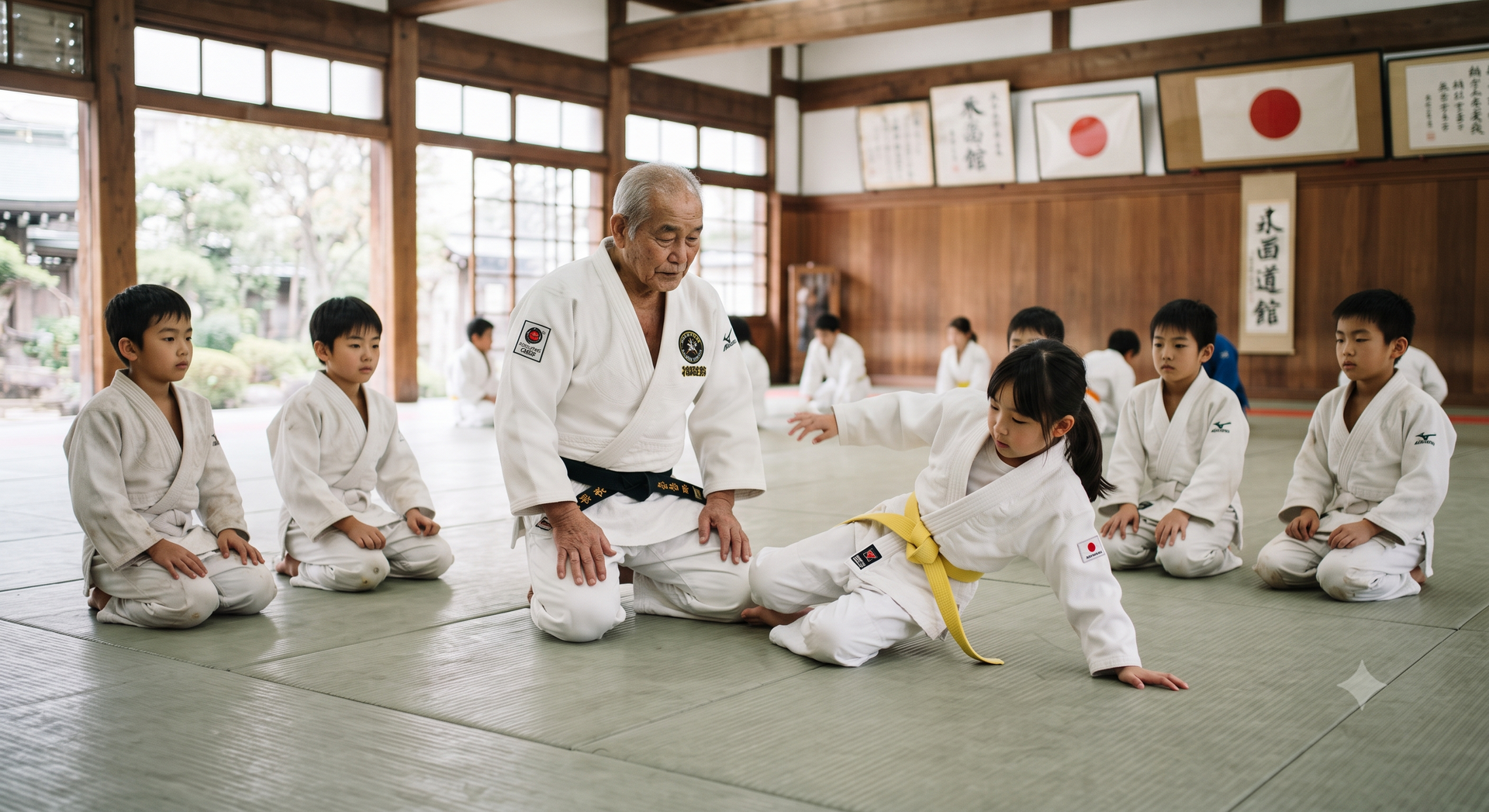
The name means "gentle way." Watch a world-class judoka execute a perfectly timed ippon seoi nage — one-arm shoulder throw and you will understand immediately why "gentle" refers to the principle of yielding and redirecting force rather than to any quality of the impact itself. A full-power judo throw, executed at world-championship level, is one of the most violent things one human being can do to another within the context of a sporting contest. The recipient hits the mat with enough force to shake the room.
This is the paradox at the heart of judo, and it is also the key to understanding why the art works. Judo's power does not come from the thrower's strength. It comes from using the opponent's own force, their momentum, their structural commitment to a direction of movement, as the engine of their own undoing. The judoka who wins is almost never the stronger person in the room. They are the person who understands leverage, timing, and kuzushi the breaking of balance more deeply than their opponent.
The Forge: The Education of Jigoro Kano
Judo is unusual among the world's major martial arts in that it has a known, documented origin and a founder whose vision for what he was creating was explicit from the beginning. Jigoro Kano was born in 1860 in Mikage, Japan, to an educated family of sake brewers with connections to the Shogunate. He was slight in build and bullied as a child, which drove him initially to study jujutsu the unarmed battlefield fighting arts of the samurai in an attempt to develop the ability to defend himself.
He studied under two of the most knowledgeable jujutsu teachers of his era, Fukuda Hachinosuke of the Tenjin Shinyo school and Iikubo Tsunetoshi of the Kito school. He was, by all accounts, an exceptionally capable student who not only mastered what he was taught but analysed the principles behind the techniques with the mind of an educator which he was, ultimately, as much as he was a martial artist.
In 1882, at the age of twenty-two, Kano opened the Kodokan dojo in Tokyo and began teaching what he called Kodokan Judo. The name was deliberate. He had extracted the most rational, effective, and safe-to-practice elements from the jujutsu traditions he had studied, eliminated the most dangerous techniques that could not be safely trained at full intensity, and built a system in which the principles of ju — yielding, maximising efficiency could be practiced daily against fully resisting opponents without the injuries that frequent full-intensity practice of traditional jujutsu would inevitably produce.
This insight that the way to develop genuine martial skill is through randori, free practice, against fully resisting partners, and that the system therefore needs to be designed to allow this safely was revolutionary. It anticipated, by almost a century, the insights that would eventually lead to the development of BJJ and modern mixed martial arts training methodology.
The Lineage: Masters and Champions
Kano's direct students spread judo across the world in the decades following the Kodokan's founding, including Mitsuyo Maeda, who carried grappling principles to Brazil and whose teaching influenced the Gracie family. But judo's development as a global institution accelerated most dramatically when it became an Olympic sport at the Tokyo 1964 Games an event of deep symbolic significance given the connection between judo and Japanese national identity.
The figures who have defined judo's competitive expression at the highest level include several whose names are recognised across the martial arts world. Yasuhiro Yamashita, who won all two hundred and three of his competitive bouts in a career spanning 1977 to 1984 and retired as the dominant heavyweight judoka in the sport's history, remains the benchmark against which all subsequent heavyweights are measured. David Douillet of France, double Olympic champion and four-time world champion, brought judo to the highest level of European sport recognition. Teddy Riner, also French, has dominated the open and heavyweight divisions for over fifteen years, winning ten world titles and three Olympic gold medals in one of the most sustained periods of dominance any judoka has achieved.
In Australia, judo has a strong community with dedicated clubs in every state and a history of international representation at Olympic and world championship level.
The Strengths: The School of Falling and Throwing
Judo's most immediate practical output is technical mastery of throwing — the ability to take a standing opponent to the ground with explosive efficiency. The depth of judo's throwing curriculum, covering entries from every angle and against every defensive counter, represents hundreds of years of accumulated tactical wisdom about how human bodies move and how movement can be redirected.
The groundwork component newaza adds pins, chokes, and joint locks that give judo practitioners a complete answer to the question of what happens once the opponent is on the ground.