Goju Ryu Karate Explained
The Balance Between Hard and Soft
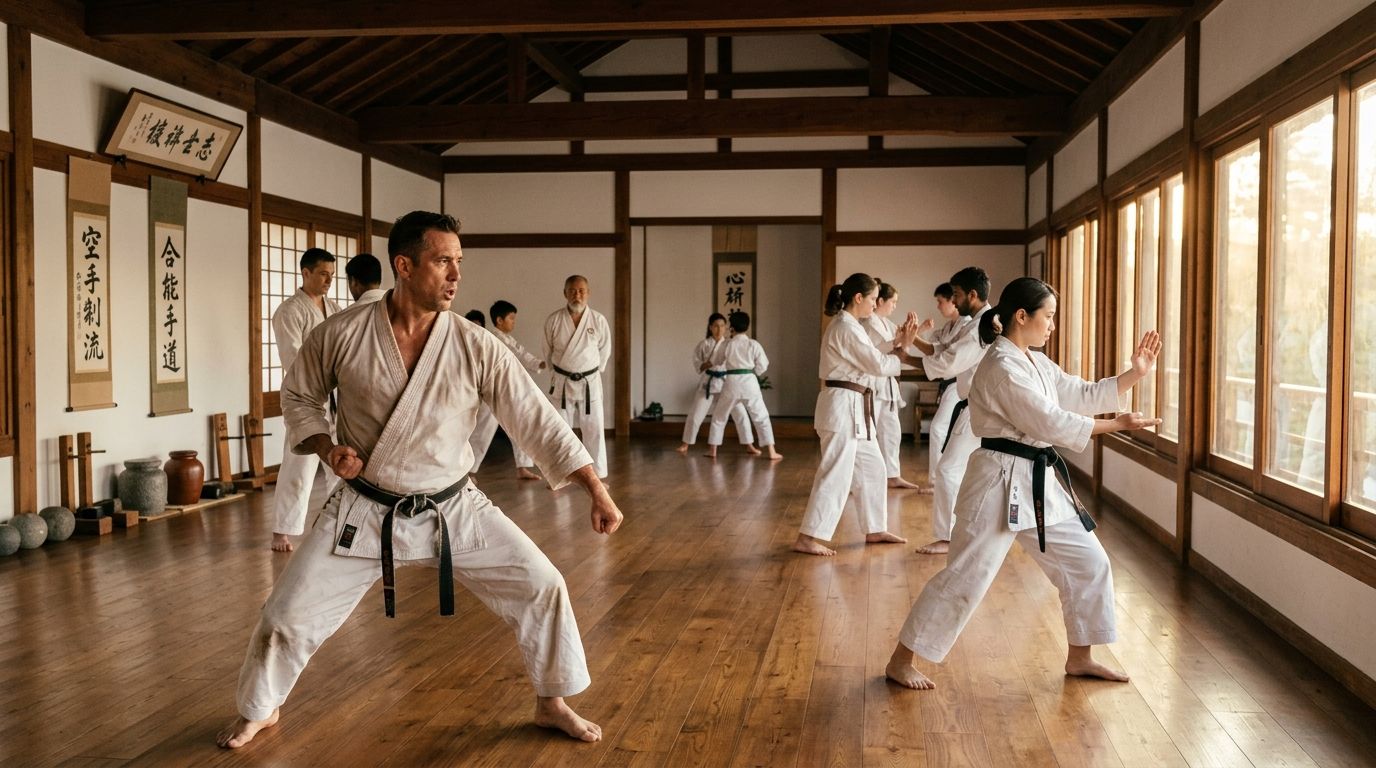
If you were to step into a traditional Goju Ryu dojo, the first thing you might notice isn’t a high kick or a fast punch. Instead, it’s the sound—a deep, resonant, and rhythmic style of breathing that seems to vibrate through the floorboards. It is a sound that signals a very specific kind of power: one that is rooted, resilient, and remarkably balanced.
Goju Ryu is one of the most popular and respected styles of Karate in Australia and around the world, but it occupies a unique space in the martial arts landscape. While many styles are known for being either "hard" and linear or "soft" and circular, Goju Ryu exists exactly at the intersection of both.
The name itself tells you everything you need to know: Go means "Hard," Ju means "Soft," and Ryu means "Style" or "School." To understand Goju Ryu is to understand the constant, fluid dance between these two opposing forces. It is an art that teaches you how to be as unyielding as a rock when necessary, and as adaptable as water when the situation changes.
The Okinawan Roots: A Blend of Two Worlds
The story of Goju Ryu begins on the island of Okinawa, a place that acted as a cultural bridge between Japan and China. In the late 19th century, a young martial artist named Kanryo Higaonna travelled from Okinawa to Fuzhou, China. There, he spent years studying the "Whooping Crane" style of Kung Fu under the master Ryu Ryu Ko.
When Higaonna returned to Okinawa, he brought back a system that was quite different from the native Okinawan Te. It was a system that emphasized close-quarters combat, circular blocks, and a powerful, isometric style of breathing. This system became known as Naha-te.
Higaonna’s most dedicated student was a man named Chojun Miyagi. Miyagi was a visionary who took his teacher’s lessons and refined them into a structured, philosophical system. He was the first Okinawan master to officially name his style, choosing the name "Goju Ryu" from a line in the Bubishi (a classic text on martial arts): "The way of inhaling and exhaling is both hardness and softness."
Miyagi’s goal wasn’t just to create a fighting system; he wanted to create a path for human development. He believed that the balance found on the training mat—knowing when to resist and when to yield—was the ultimate secret to living a successful and harmonious life.
The Philosophy of "Hard" and "Soft"
In the context of Goju Ryu, "Hard" and "Soft" are not just physical descriptions; they are strategic and philosophical principles.
What is "Go" (Hard)?
The "Hard" aspect of Goju Ryu is what most people recognize as Karate. It involves closed-fist strikes, strong linear kicks, and braced, stable stances. In a self-defence situation, "Hardness" is the ability to absorb an impact or to deliver a decisive strike that ends a conflict immediately. It represents the physical strength, conditioning, and unwavering resolve needed to face a challenge head-on.
What is "Ju" (Soft)?
The "Soft" aspect is where Goju Ryu shows its Chinese Kung Fu heritage. It involves open-hand techniques, circular deflections, and the use of an opponent’s energy against them. Instead of meeting a punch with a hard block (bone against bone), a Goju Ryu practitioner might use a circular parry to "ride" the attack and redirect it. "Softness" also refers to the internal state—staying calm, flexible, and relaxed even under immense pressure.
The Integration
The true magic of Goju Ryu happens when these two are used together. Imagine a wave hitting a cliff. The cliff is "Hard," but the water is "Soft." The water doesn't try to break the cliff; it flows around it, finding every crack and eventually wearing the stone away. In training, this might mean using a "Soft" circular movement to enter an opponent's space and then delivering a "Hard" strike once their balance is broken.
The Breathing: The Engine of the Style
You cannot talk about Goju Ryu without talking about Sanchin.
Sanchin (meaning "Three Battles"—mind, body, and spirit) is the foundational kata of the style. It is a slow, tension-heavy pattern that focuses almost entirely on a specific type of breathing called ibuki.
In Sanchin, the practitioner moves through a series of strikes and blocks while maintaining a state of isometric tension. The breath is forced out from the diaphragm with a distinct sound. This serves several purposes:
- Internal Strength: It conditions the internal organs and the core muscles to withstand impact.
- Rooting: It connects the practitioner firmly to the ground, creating a stable platform for power.
- Mental Focus: It forces the mind to stay entirely present in the body.
If Sanchin represents the "Hard" breathing, its counterpart is Tensho. Created by Chojun Miyagi later in his life, Tensho is a "Soft" kata that features fluid, open-hand movements and a softer, more natural breathing pattern. Together, Sanchin and Tensho represent the two poles of Goju Ryu.
Technical Characteristics: Close-Range Combat
Unlike some styles of Karate that prefer to stay at a distance and use long-range "blitz" attacks, Goju Ryu is famously a close-range system.
Kakie (Sticky Hands)
One of the unique training methods in Goju Ryu is Kakie. Much like the "Pushing Hands" of Tai Chi or the "Chi Sao" of Wing Chun, Kakie involves two partners maintaining contact with their wrists while pushing and pulling.
This drill develops a "tactile sensitivity." It teaches you to feel where your opponent’s weight is shifting and where their balance is weak. In a real-world self-defence scenario, most fights happen at a very close distance. Kakie ensures that a Goju Ryu practitioner is comfortable in that "pocket," knowing how to use short-range elbows, knees, and joint locks to control the situation.
Body Conditioning (Hojo Undo)
Goju Ryu also places a heavy emphasis on traditional strength training using implements like:
- Chi-ishi: Weighted stone levers used to strengthen the wrists and grip.
- Ishisashi: Stone padlocks used like modern kettlebells.
- Nigiri-game: Gripping jars filled with sand, used to build a crushing grip and strong stances.
For the Goju Ryu practitioner, the body is the primary weapon. This traditional conditioning ensures that the "Hard" part of the style is backed up by genuine physical power and resilience.
The Kata Curriculum
Goju Ryu has a relatively small but deep library of kata. Each one is designed to teach a specific set of principles.
- Gekisai Dai Ichi & Ni: Created by Miyagi to introduce beginners to the basic movements and the transition between hard and soft.
- Saifa: The first of the advanced kata, focusing on breaking away from a grab and using circular strikes.
- Seiyunchin: A legendary kata that uses no kicks at all. It focuses on low, stable stances and powerful grappling/throwing techniques.
- Shisochin: Often described as the "four directions" kata, it emphasizes open-hand strikes and joint manipulation.
- Suparinpei: The longest and most complex kata in the system, containing the most advanced expressions of the Goju Ryu philosophy.
Goju Ryu in the Modern World: The Australian Context
Goju Ryu has found a very welcoming home in Australia. Our sporting culture often values "toughness" and resilience, but there is also an increasing Australian interest in the mental health and wellness aspects of martial arts.
Because Goju Ryu balances intense physical conditioning with deep breathing and moving meditation, it appeals to a wide demographic. We see:
- Younger students drawn to the power and the self-defence practicality.
- Professional adults using the "Soft" aspects and the focused breathing to manage work-related stress.
- Older practitioners finding that the "Ju" (soft) principles allow them to continue training and improving their mobility long into their senior years.
In a modern world that is often chaotic and "hard," the lesson of yielding and finding the "soft" path is more relevant than ever.
Why Every Style Has Value: The Lesson of Goju Ryu
In our "Every Style Has Value" series, Goju Ryu stands as a perfect example of why we shouldn't judge a book by its cover. To a casual observer, a Goju Ryu class might look aggressive or overly tense. But once you look deeper, you find a system that is profoundly interested in harmony.
The "Hardness" is there to protect, and the "Softness" is there to connect. By training in Goju Ryu, a student learns that they don't always have to shout to be heard, and they don't always have to fight to win. Sometimes, the most powerful thing you can do is breathe, yield, and find a better way through.
The Journey of Self-Mastery
Whether you are interested in the historical Okinawan roots, the practical close-range self-defence, or the unique health benefits of isometric breathing, Goju Ryu offers a lifetime of study. It is a style that doesn't ask you to choose between being a warrior or a scholar—it asks you to be both.
As Chojun Miyagi once said, "The purpose of Karate is to be used as a means to help people in the daily affairs of life." By finding the balance between "Hard" and "Soft" on the mat, we learn how to find that same balance in our families, our careers, and our communities.
Start Your Goju Ryu Journey
If the philosophy of balance and the strength of traditional Okinawan training resonates with you, there is no better time to start than now. Australia is home to many world-class Goju Ryu schools, ranging from traditional Okinawan lineages to modern sporting applications.
Martial Arts Australia is committed to helping you find a legitimate, high-quality dojo where you can begin this transformative journey.
Martial Arts Masters Blog