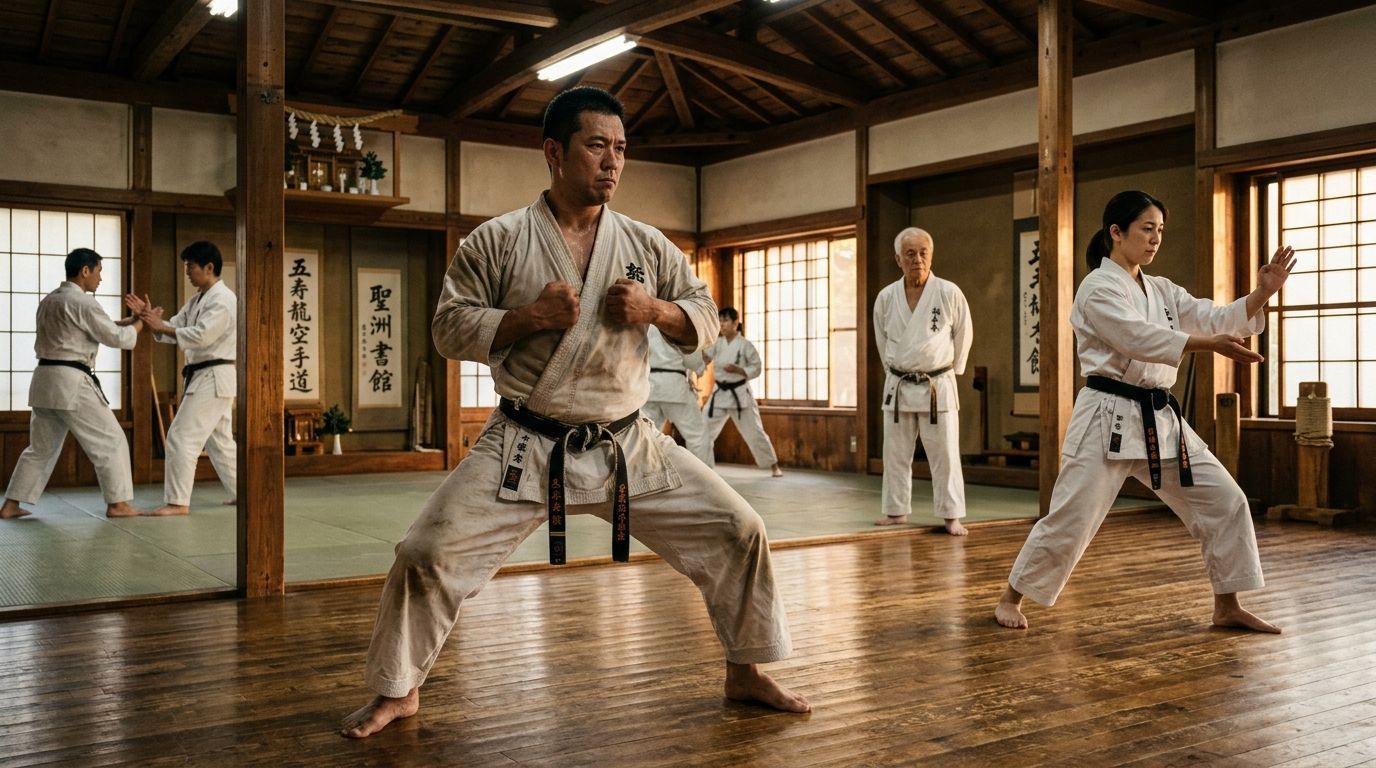
Kung Fu: The Ocean of Chinese Martial Arts and Its Endless Depths
Five Thousand Years of Fighting Philosophy, Living Masters and the Styles That Changed the World

If you ask what kung fu is, you have asked a question that cannot be answered in a single sentence. You might as well ask what European literature is, or what Asian cuisine is. Kung fu a term that in its original Chinese means simply "skill acquired through great effort" and has become, in English usage, the collective name for Chinese martial arts is not a single system. It is a vast, diverse civilisation of fighting arts accumulated across five thousand years of Chinese history, across every province and ethnic group, through monasteries and military systems and secret societies and individual masters who passed their knowledge through family lines that stretch back generations beyond recorded memory.
What unites these arts beneath a single name is not their technique which varies enormously but their origin in a shared cultural, philosophical, and historical context that is unlike anything else in martial arts.
The Forge: China's Deep History of Martial Practice
Chinese martial arts history stretches back to the Xia Dynasty (circa 2070 BCE), with legendary accounts of the Yellow Emperor Huangdi practicing and systematising fighting techniques. While legend and history are difficult to disentangle at this remove, the martial arts references in texts from the Zhou Dynasty (1046–256 BCE) are well-documented, and the systematic development of military and civilian fighting arts across Chinese history is one of the most extensively recorded traditions in the world.
The systems that have had the greatest influence on global martial arts culture emerged from a complex interplay of geography, philosophy, and practical necessity. Buddhist influence, most famously associated with the Shaolin Temple in Henan Province, produced some of the most celebrated martial arts lineages in Chinese history. The Shaolin Temple, founded in 495 CE, became associated with martial arts practice through the legendary figure of Bodhidharma known in Chinese as Damo who is credited in tradition with introducing both Chan (Zen) Buddhism and exercises that became the foundation of Shaolin martial practice to the monks in the sixth century.
Whether this account is literally accurate or represents a later attribution is debated by historians, but the historical fact of the Shaolin Temple's martial arts tradition and its extraordinary influence on Chinese fighting arts is not in doubt. Styles that trace their lineage to Shaolin, or that developed in deliberate contrast to it, account for a substantial portion of the Chinese martial arts that exist today.
The philosophical dimension is essential to understanding kung fu in a way that distinguishes it from most other martial traditions. Confucian values of loyalty, respect, and moral cultivation; Taoist principles of natural flow, yielding, and working with rather than against natural forces; Buddhist concepts of mindfulness, compassion, and the cultivation of inner quality all of these are woven into the philosophical frameworks of different Chinese martial arts in ways that make them explicitly and self-consciously about more than fighting.
The Lineage: Systems and Their Living Keepers
Wing Chun is perhaps the Chinese style most widely practiced in the Western world today, due largely to the extraordinary fame of one of its most celebrated practitioners. Bruce Lee trained under Yip Man the master who brought Wing Chun from Foshan to Hong Kong and trained the majority of the modern Wing Chun lineage in his youth before developing his own approach to martial arts. Yip Man's most senior students, including Wong Shun Leung and Leung Sheung, continued teaching after his death in 1972 and established the Wing Chun lineages now practiced globally.
Tai Chi Chuan, which has become globally known as a health practice and is practiced by millions of people worldwide in park-based group settings, is also a genuine martial art of considerable depth in its traditional forms. The Yang family style, developed by Yang Luchan in the nineteenth century and disseminated globally in the twentieth century, is the most widely practiced. Push hands the interactive partner practice of Tai Chi Chuan develops sensitivity to a partner's force and the ability to redirect it in ways that connect directly to the art's historical function as a martial system.
Baguazhang, Xingyiquan, and Tai Chi Chuan together form the three arts of Chinese internal martial arts, each based on principles drawn from Taoist cosmology and each representing a distinct approach to power generation and tactical movement. These arts are less widely practiced than their external counterparts but are considered by many Chinese martial arts scholars to represent the deepest technical achievement of the tradition.
The Strengths: Philosophy Embodied in Motion
The breadth of kung fu's physical development is genuinely unmatched — the range of styles encompasses circular and linear technique, striking and grappling, weapons and empty hand, hard and soft power generation, close-range and long-range fighting principles. A practitioner who has seriously explored multiple Chinese styles over a lifetime has access to a technical vocabulary that no single-system practitioner can match in terms of sheer scope.
The weapons curriculum preserved in traditional Chinese styles staff, spear, sword, broadsword, and dozens of specialised weapons specific to regional traditions represents a genuine historical treasure, a living archive of tools and tactics refined over millennia of actual application in the context of real conflict, preserved in movement.
The most distinctive long-term gift of traditional kung fu practice, in my experience, is the development of yi intent, the conscious direction of attention and will in practice and the understanding that martial technique is ultimately an expression of the quality of mind brought to it, not simply of physical skill.