Mixed Martial Arts: The Sport That Asked the Question Every Martial Artist Was Avoiding
How MMA Changed the World's Understanding of Combat and Became a Global Sport
For most of martial arts history, the question of which style was most effective was debated endlessly and answered almost never. The debates happened in dojos, in magazines, at seminars but they were rarely settled by actual test, because testing the question properly required precisely the kind of open, rules-minimal competition that most martial arts organisations had no mechanism for conducting and that the culture of individual styles had no interest in enabling.
Then UFC 1 happened in 1993, and the answer began to emerge not as a declaration from any authority but as an observable, repeatable pattern across hundreds of hours of competition footage: striking arts without grappling were vulnerable once the fight went to the ground; grappling arts without striking were vulnerable at long range before engagement; and the practitioners who understood how to connect these ranges and transition between them were consistently defeating those who could not.
Mixed Martial Arts did not create new techniques. It created a laboratory in which the effectiveness of existing techniques could actually be tested against fully committed opponents under conditions approaching real combat, and then refined continuously in response to what the testing revealed. The result is a genuine technical synthesis the most complete picture of what works in stand-up unarmed combat that has ever been developed.
The Forge: Vale Tudo, the Gracies, and the Birth of a Sport
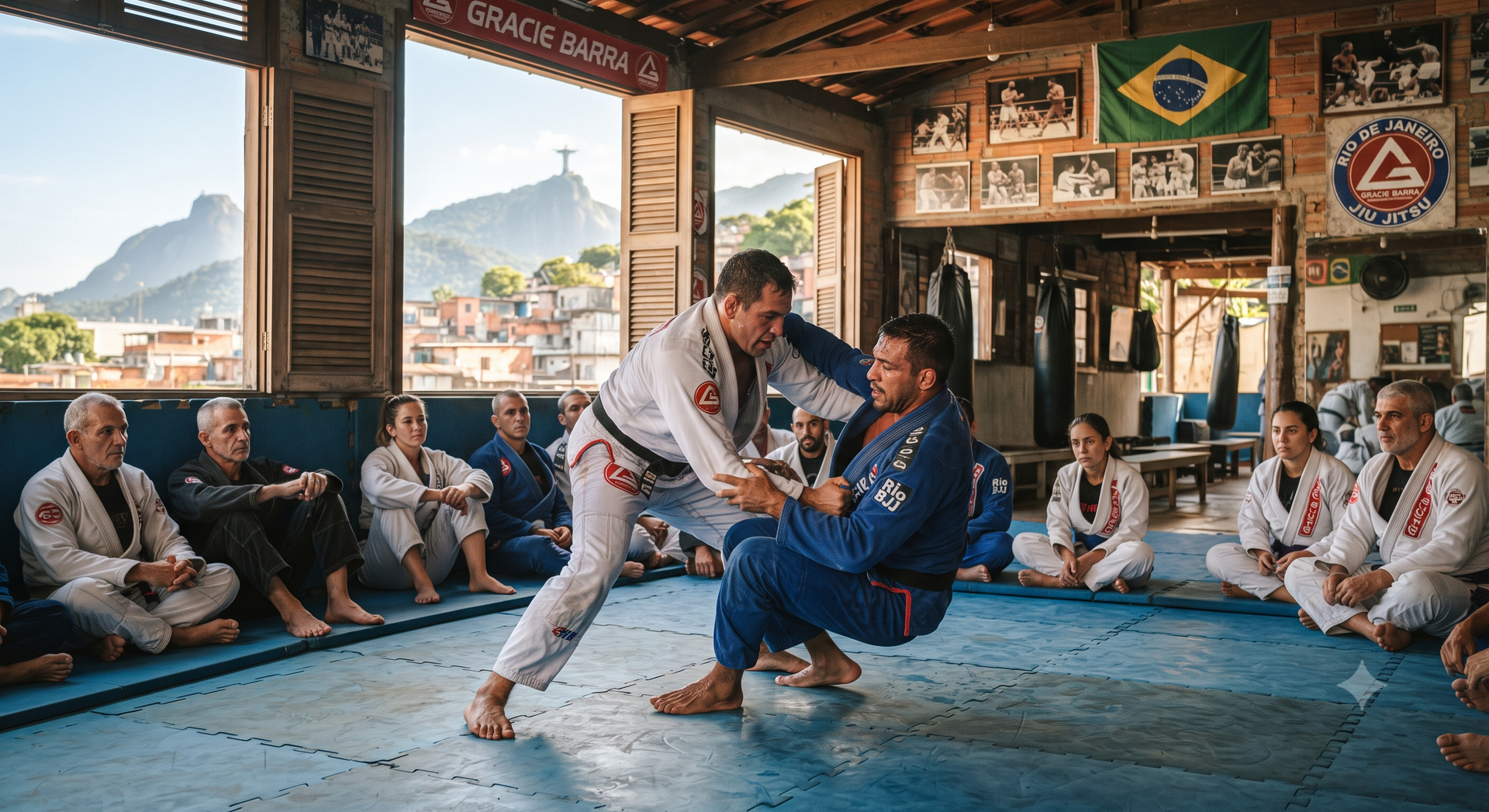
MMA's direct lineage runs through several parallel tracks that converged in the early 1990s. In Brazil, vale tudo "anything goes" competition had been a feature of martial arts culture for decades, providing an unrestricted test of fighting principles that the Gracie family had used to validate and refine Brazilian Jiu Jitsu against opponents from every background. The Gracies' open challenges, which they issued throughout the mid-twentieth century and accepted fighters of every style against, produced the most extensive real-world testing of a specific martial arts system that had been conducted in modern times.
In the United States, Art Davie, a marketing consultant with a background in combat sports, and Rorion Gracie one of Hélio Gracie's sons who had established himself in California developed the concept that became the Ultimate Fighting Championship. The first event, held in Denver, Colorado in November 1993, was conceived explicitly as a tournament to determine which martial art was most effective, with minimal rules and no weight classes. Royce Gracie's victories over larger opponents from other disciplines he defeated three opponents on the same night were exactly the demonstration of BJJ's effectiveness that the event was designed to produce.
The sport that emerged from this origin was initially controversial, attracting political opposition in the United States that led to significant regulatory challenges in the mid-1990s. The purchase of the UFC by Zuffa LLC headed by Dana White and brothers Lorenzo and Frank Fertitta — in 2001 marked the beginning of the sport's professionalisation and the development of the athletic commission regulatory framework that transformed MMA into a legitimate sport with consistent rules, weight classes, and the safety measures that made it sustainable as a mainstream athletic enterprise.
The Lineage: The Figures Who Shaped Modern MMA
The names that have defined MMA's technical and competitive evolution read like a roster of martial arts history.
Chuck Liddell, the UFC light heavyweight champion who dominated the early 2000s, demonstrated that elite Muay Thai-based striking combined with sprawl-and-brawl wrestling defence could be built into a complete, champion-level fighting system. Randy Couture, a two-time Olympic alternate wrestler who translated his grappling foundation into one of the most successful MMA careers in the sport's history, showed that elite wrestling was the most reliable single martial arts foundation for MMA success.
Anderson Silva, who held the UFC middleweight championship for a record-breaking 2,457 days, brought a level of striking artistry — drawn from his deep background in Muay Thai and capoeira that redefined what offensive technique in MMA could look like at the highest level. Georges St-Pierre, the dominant welterweight champion whose background in karate was built into a comprehensive wrestling-and-striking game, demonstrated the importance of wrestling-based control in dictating the terms of a fight.
Khabib Nurmagomedov, who retired undefeated as UFC lightweight champion, showed how Sambo and wrestling backgrounds — translated into a suffocating top pressure game could produce absolute dominance even over elite strikers. Conor McGregor, whose background in boxing and karate produced some of the most spectacular knockout performances in MMA history, and whose career trajectory illustrated both the heights that exceptional striking can reach and the challenges of MMA's grappling dimension.
In Australia, Alexander Volkanovski who held the UFC featherweight championship for multiple years and fought across weight classes at the absolute peak of the sport became one of the most recognised and celebrated MMA practitioners the country has produced, his achievements placing Australia firmly on the global MMA map.
The Strengths: The Complete Martial Athlete
MMA's primary strength as a developmental system is its completeness under test conditions. Because MMA training requires genuine proficiency across striking, wrestling and takedown, and ground fighting, a practitioner who has trained seriously in an MMA context cannot hide weaknesses in any range the way a practitioner of a single specialised art can. The system self-corrects constantly, because weaknesses are exposed and addressed through sparring rather than preserved by limiting training to a single range.
The fitness required for MMA training and competition is among the highest of any combat sport the combination of cardiovascular demand, strength, explosive power, and technical precision required across multiple disciplines produces athletes of extraordinary general physical capability.
The training methodology that effective MMA gyms have developed balancing technical drilling, specific sparring, and full sparring in a way that maximises learning while managing injury risk represents one of the most sophisticated approaches to combat sports training currently practiced.