Graham Slater - Blitz Article Vol 23 No 6
An interview with Graham Slater that appeared in Blitz Magazine (this is not the exact published interview so please purchase a back issue of Blitz to read it Vol 23 No 6
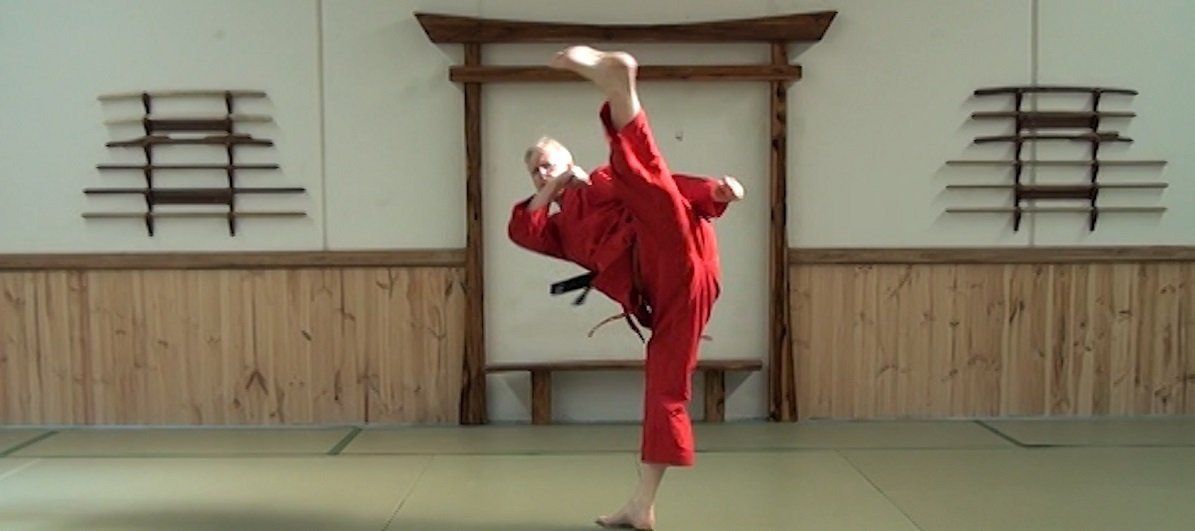
1. The IMA's stated primary aim is to bring martial artists together to cross-train and share knowledge. What value would you place on this aspect of what the IMA does — what has it done for you personally as a martial artist and instructor?
After cutting my teeth on hard karate styles ‘Goju, Kyokushin & Shotokan' my view on martial arts was it had to be hard, fast and brutally powerful. There was no room in my mind for soft and circular – Aikido, Tai Chi, Kung Fu, etc. I was ignorant and dismissed other styles if they didn't look a certain way on the surface.
As my experience in martial arts grew and my mind began to open to other possibilities, I formed the IMA Circle of Knowledge so that instructors from all schools could come together and share their knowledge and unique skills with each other.
This process opened my mind, not only to new techniques but also to new philosophies and cultures and has been one of the most important elements in my growth as a martial artist. Many of our members report similar experiences to me.
2. How is this sharing facilitated? (Describe how the IMA works in this capacity)
We hold our well-known “Circle of Knowledge” open training sessions where various instructors will teach their favourite topic for say twenty minutes at a time over a 2-3 hour session. Everyone who attends is free to accept or reject anything that is presented, no egos, just friendly training.
Imagine performing a technique you thought was very effective and when you tried it on a person from another style it didn't work? This is a fear many instructors face when they move outside of their comfort zone but, for martial arts, we need to get out of that space if we want to learn and grow.
At our training sessions everyone comes in on an equal footing and the structure ensures that no one looses face. The atmosphere is open and members tell me that the have fun, learn new things and feel encouraged to introduce those new skills to their own students.
As IMA membership grew we set up these types of training sessions in each state, headed by a regional director. Before we knew it we had numerous schools around the world asking if they could do the same. We have since had instructors travel from one country to another, training at various IMA flagged schools and being warmly welcomed.
Sharing knowledge is the founding concept of the IMA and as our membership has expanded we have developed the model to provide a complete range of services for our members and their schools. As a large association we have been able to search out and negotiate better deals on everything from insurance to martial arts equipment to industry specific training courses and so our initial idea of sharing knowledge has expanded to help instructors with their business as well as their training.
3. Give us an example of a great experience you've had as a result of this…
I've been running the IMA and the Circle of Knowledge for over 15 years now and every time we meet and share our skills I come away with something new that makes me re-evaluate and improve my art. That's a great experience to my way of thinking. Recently though, being involved with the IMA has opened the way to some interesting experiences.
I've trained in the Shotokan katas for 30+ years but haven't had a direct teacher since 1988. Anyway, for some years I had heard about a very interesting teacher in South Africa. I then read some articles about him, watched his videos and thought that I would love to learn from him. He used to run a huge karate group over there (20,000+ students) and then he immigrated to Australia. I'm talking about Sensei Stan Schmidt. Being part of the IMA led me to being invited to another association's function where I met Sensei Schmidt.
I'm always bringing instructors together and arranging for people to train so it's nice when it happens to me. Now I have private lessons with Sensei Schmidt and have found a new appreciation for Shotokan karate and how to apply my technique with more impact. I'm always looking for new ways to improve.
Here's another recent anecdote. I'm always inviting members of other associations to come to our training sessions and functions. Because we are always offering the hand of friendship and cooperation we often find that spirit reciprocated in kind. A few years back the Bob Jones Corporation invited me to one of their national weekend camps. I was the only outsider to train on that camp and it was a fantastic experience.
4. Tell us a little bit about your development as a martial artist — what is the system you teach personally, and how have you drawn from all your various training in putting together your syllabus?
I started studying martial arts some 35 years ago with Goju karate in England. When I came to Australia I started training in two karate styles Kyokushin and Shotokan and kickboxing. No one told me I had to focus on only one art; I just wanted to gain as many skills as I could in the fastest time frame.
Those clubs closed and I found myself doing another style of karate called Shotokai but I also had friends that did Aikido and Ju Jitsu so I would train with them too.
When I started travelling through Asia I was introduced to several new methods, including an esoteric art called Shintaido. Recently, I've been working with Shaolin Monks, since we are involved in sponsoring them to come to Australia to teach.
In 1997 I combined all that I believed to be important in a martial arts and created Reikijitsu Kai which combines Shotokai karate, Aikido, JuJutsu, Tai Chi, Shintaido and the energy healing elements from Qigong and Reiki.
My students want to know if I'm going to add elements of Shaolin Kung Fu to the list of arts in Reikijitsu? At this point I'm just having fun learning their dynamic forms and trying not to pull too many muscles in the process.
5. I notice the IMA is promoted as a ‘peak body' in the martial arts industry. There has been some confusion in recent years, with some martial arts industry groups claiming to be ‘the' peak body, when in fact there are many recognised peak bodies. Can you briefly explain what a peak body is and how the IMA fits this tag?
There are some individuals and groups that feel that this tag should be exclusive to them because they don't want competition. Some feel that an association must be a National Sport Body (NSO) recognisted by the Australian Sports Commission to be a peak body, but you don't.
The main benefit of being an NSO is the access you have to government funding and we have never needed it because of the way we manage and invest funds. We do qualify to be a NSO and it is something we are considering purely to enable us to sponsor athletes from any style or school. I've seen superb athletes competing in the NAS and other mixed styled tournaments and I think that they should have every right to access government sponsorship along with swimmers and cyclists.
With an industry as diverse as martial arts we can't say that any one individual or association is ‘the' peak body. From the IMA's point of view, we didn't just decide to start calling ourselves a “peak body”. It has been a term that government, corporations and other groups have used to describe us, for a long time, because of the things we do.
We examined a university study that defines a “peak body” (the document can be viewed on our website) and decided that the term was an acceptable label for the functions we perform :
•Serve industry needs through active consultation;
•Provide extensive services and products to industry;
•Contribute to education and provide support and direction;
•Provide a strong and united voice for the industry on state and national levels;
•Generate and maintain a position of trust, confidence and respect in the industry;
•Facilitate the availability of nationally recognised training;
•Lobby and work with local and national levels of government;
•Liaise with corporations – insurance companies
•Work to promote/expand and project the industry's profile;
•Become a reference point through industry expertise and knowledge;
•Represent a substantial portion of the industry (large membership base);
•May be a private company, government dept or a non profit association;
•Governance should be transparent, with regular open industry-wide meetings.
6. What are the biggest issues facing martial arts instructors and school owners, in your opinion, and what services does the IMA have in place to assist with these?
I make it a point to try and answer the phone and read my emails personally so I can keep my finger on the pulse. By communicating with around 1500 instructors each month I feel confident I can answer your question accurately. These are the top four issues facing instructors and school owners:
• Lack of information on changing legislation relating to martial arts.
Many instructors are looking over their shoulder for fear of the government preventing them from teaching. It's not an unwarranted fear either. There are a lot of people who are not being approved for the Working with Children check. We feel it is our job to inform as many instructors as possible about changes in government policies and help them work within the law.
(2&3) Appropriate qualifications & insurance
More instructors are being asked by consumers and venue hirers if they are appropriately qualified and possess insurance. The fact is many instructors, from a legal standpoint, don't have suitable qualifications to teach martial arts and as a result find it hard to obtain insurance at affordable rates.
The IMA helps instructors “up-skill” their qualifications and notifies them whenever there are changes to legislation that they need to address.
(4) Finding a working model for a successful school or association.
Instructors want to know the best method of recruiting and retaining more students. The truth is there is no single method and what works for one school may not necessarily work for another.
We recruit consultants and successful school owners to share their business models on our seminars. If an instructor can't attend the seminar we will still send them out materials so that they can continue to learn and be exposed to new ideas. I meet a lot of instructors that have years of martial arts experience and high level skills but are still unsure as to how to run their school as a business. This is where we can help. The IMA is about sharing the knowledge martial artists need to succeed in all aspects of their art.
7. This month, the government's ‘Working With Children' check system will come into force. How will that affect instructors and what involvement, if any, will the IMA have in helping roll out this legislation?
The legislation is quite clear. Any instructors paid or unpaid, coaching anyone deemed to be a child (under 18 years of age) without a WWC would be breaking the law.
The IMA has been approached by the Justice Department to help inform as many instructors as possible. Our role has been to arrange industry meetings, circulate material to the members and associates on our database and post the forms and information on our website.
The next big issue will be weapons licensing and how it restricts instructors from teaching their curriculum. It is an issue that is a major concern for over 50% of all martial arts schools in Australia and I want to make sure that the martial arts community understands the legislation and how they can work within it or work to change it.